
Ceramic rings are a core biological filter media line, but one ring format does not fit every filter or retail program. Equipment dimensions and channel needs should set the SKU.
Canister filters impose tight basket dimensions and defined internal flow paths. Sumps usually provide more open chamber space and more flexibility in media containment. For a wholesale buyer, the decision is whether the selected size, shape and pack format make sense for the equipment, sales channel and repeat-order plan.
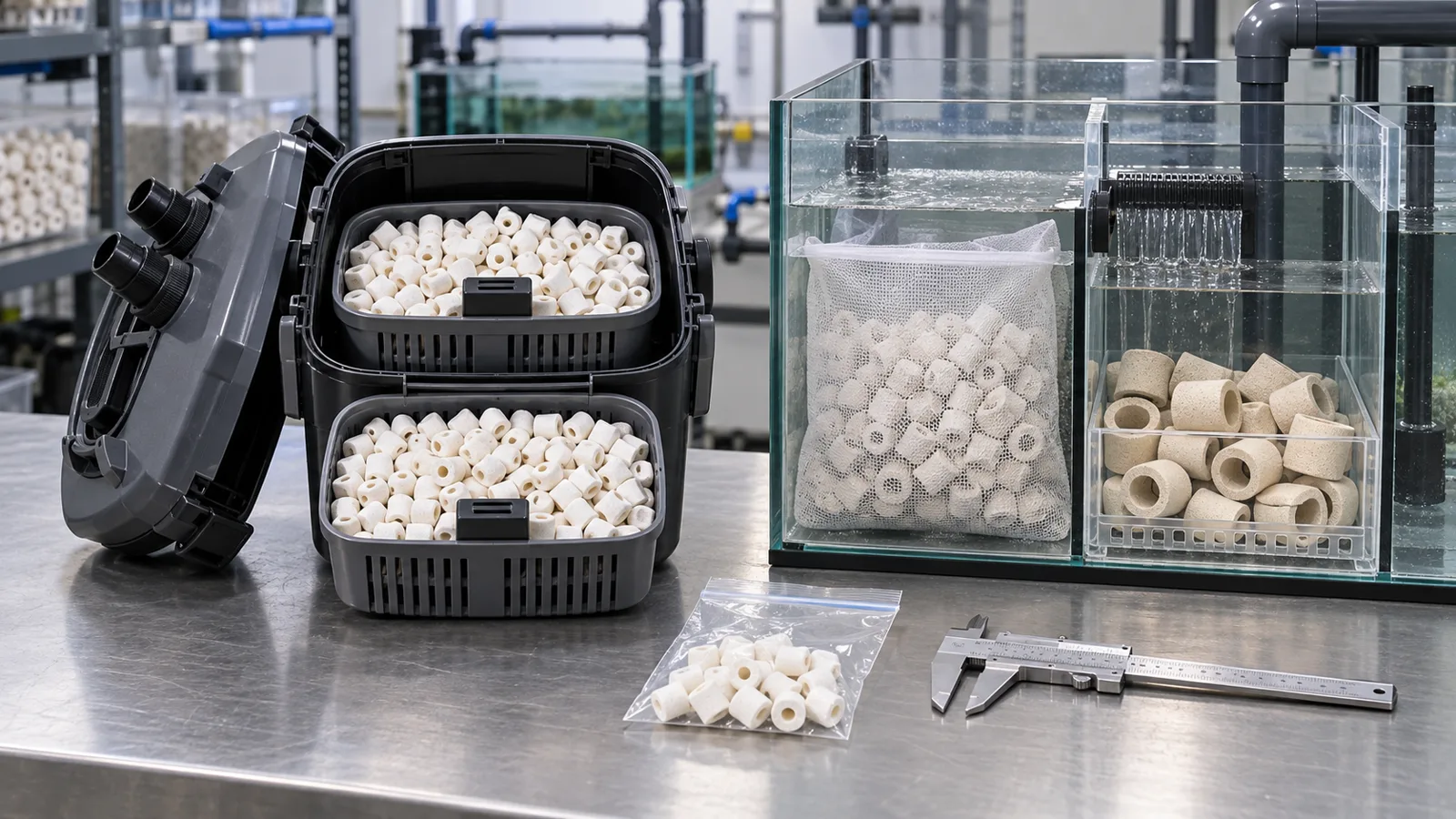
| Buying decision | Canister refill | Sump media pack |
|---|---|---|
| Fit check | Basket slots, central tubes and lid clearance | Chamber, support tray and removal opening |
| Sample trial | Fill and close the actual basket | Load and remove the proposed bag or tray |
| Pack approval | Refill weight for the named equipment | Handling weight and containment format |
Begin with the equipment dimensions
Ask for the usable media space, not only the external filter model. In a canister filter, the relevant measurements are the internal basket length, width and depth, the number of baskets, the size of the basket slots, and the clearance needed for lids, handles and central tubes.
For a sump, record the biological chamber dimensions, baffle height, water direction, access from above, and whether the media will sit in a tray, crate or mesh bag. Also note the narrowest opening through which the packed media must pass during installation or maintenance.
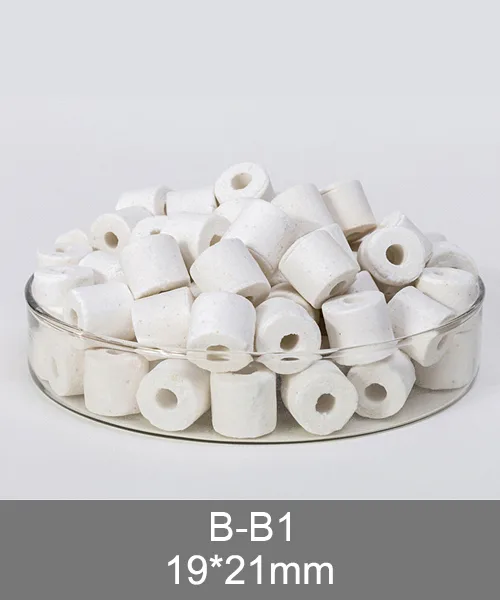
These dimensions determine the practical media size. A ring that looks normal beside a ruler may bridge across a small canister basket, leave unused gaps, or interfere with the basket lid. A larger ring can be easy to handle in a sump but inefficient in a compact cartridge or small retail pack.
Canister filters favour compact, predictable formats
Canister baskets have limited volume and a defined assembly sequence. Compact ceramic rings are easier to distribute across the basket and around internal features. Consistent dimensions matter because oversize pieces can prevent a basket from seating correctly or create large voids in a small media space.
- Outside diameter or width
- Ring length
- Centre-hole size
- Variation across a production sample
- Whether pieces pass through basket slots
- Fill weight and settled height in the actual basket
- Clearance for the basket lid and filter head
- Dust released during filling and transport
The basket should not be packed so tightly that water has no clear route through the media. At the same time, an undersized retail pack can look incomplete when the customer follows the equipment instructions. Test the proposed net weight in representative baskets before printing the package claim.
Sumps allow more freedom, but still need a defined water path
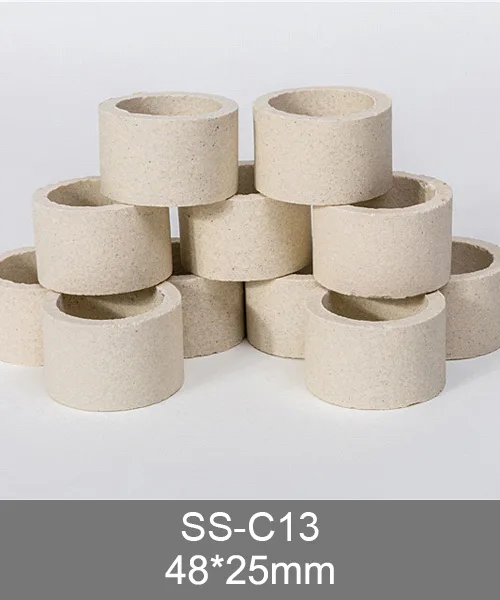
An aquarium sump may accept larger rings, mixed shapes or higher media weights because its biological chamber is more open. That flexibility does not remove the need for a specification. Media placed in a low-flow corner or piled above the working water path does not use the chamber efficiently.
Confirm whether the rings will be loose in a dedicated tray, retained inside a mesh bag, loaded into a removable crate, combined with other media, placed after mechanical filtration, or submerged continuously.
The containment method changes the usable dimensions. A mesh bag restricts the mass into a single bundle and may make removal easier, while an open tray spreads the media more evenly. The buyer should define the supplied format instead of leaving the final arrangement to a product photograph.
Do not use piece size as a performance claim
A larger ring is not automatically better for a sump, and a smaller ring is not automatically better for a canister. Size changes packing behaviour, open space, piece count and handling. It does not establish biological capacity on its own.
Porous ceramic media provides a surface on which biofilm can develop. Actual biological filtration depends on the complete operating system, including flow, oxygen, water chemistry, temperature, loading, prefiltration and maintenance. Avoid converting ring dimensions or visible pore size into unsupported ammonia-removal or aquarium-capacity claims.
If a supplier provides technical numbers such as water absorption, apparent porosity or surface area, request the method, unit, sample identification and report date. Use those values only within the limits of the method.
Decide whether the media is supplied loose or bagged
Loose ceramic rings maximise flexibility for equipment manufacturers and bulk distributors. They can be weighed into proprietary baskets, service kits or local retail packs. The buyer must then control dust, handling and the final pack operation.
A mesh bag creates a ready-to-use unit and can simplify sump maintenance. In a canister basket, however, the bag seam, drawstring and folded mesh consume space. Test the filled bag in the actual basket; a nominally correct weight may become too bulky once the rings are contained.
- Mesh opening and material
- Bag finished dimensions
- Closure type
- Net media weight
- Maximum filled thickness
- Named basket or chamber fit
- Outer printed pouch or box
Do not advertise universal fit unless the product has been checked across the stated equipment range.
Build separate retail packs when the use case is different
The same ceramic composition can support more than one commercial SKU. A compact canister refill might use small rings in a lighter pouch, while a sump product might use larger pieces in a heavier bag, jar or bucket. Exact weights should be selected from the target market and confirmed through real packing trials.
- State the ring model or dimensions.
- Identify whether a mesh bag is included.
- Use a product photograph that matches the supplied format.
- Give net content in the form required by the destination market.
- Avoid artwork that shows incompatible equipment.
- Assign a separate barcode when media size or accessories change.
This separation reduces returns and customer-service questions. It also lets the distributor reorder the correct media without relying on colour or a generic “ceramic rings” name.
Compare landed cost, not only price per kilogram
Two ring formats quoted at the same price per kilogram can produce different commercial results. Piece size and bulk density affect pouch dimensions, pieces per pack, carton count and freight volume. A mesh bag or inner box adds material and packing time but may improve the finished offer.
- Media cost per retail unit
- Primary packaging and label cost
- Mesh bag or accessory cost
- Retail units per export carton
- Carton gross weight and dimensions
- Pallet or container utilisation
- Expected dust or breakage allowance
- Local repacking labour
Approve the ring and the pack together
Request production-representative ring samples and enough quantity to fill the proposed basket or sump pack. Measure several pieces, weigh the fill, close the retail package and place it in the export carton.
- Model code and nominal dimensions
- Accepted dimensional and colour range
- Net weight and packing tolerance
- Contained or loose format
- Acceptable chips, dust and broken pieces
- Retail pack dimensions
- Units and gross weight per carton
- Dated photographs or a retained reference sample
For the first bulk run, inspect early packed units before all printed material is consumed. Repeat orders should be checked against the same reference rather than against memory.
A practical assortment decision
Choose a canister-focused ring when the commercial priority is compact basket fit, predictable refill weight and compatibility with smaller aquarium equipment. Choose a sump-focused ring when the channel uses open biological chambers, larger media bags or higher-weight packs and values easy handling over compact basket fill.
Some brands need both. Keep the distinction visible in the model code, pack image and product copy. Two clearly specified SKUs are easier to sell and reorder than one universal claim that leaves equipment fit undefined.
Inquiry checklist for ceramic ring programs
- Target filter type and equipment models
- Basket or chamber internal dimensions
- Preferred ring dimensions or sample models
- Loose, mesh-bagged or tray-loaded format
- Proposed net weight per retail unit
- Retail pouch, jar, box or bucket requirement
- Expected quantity by SKU
- Destination market and label language
- Carton-weight or pallet limits
- Required sample and inspection process
Send equipment and packing details
UJW supplies Ceramic Rings in multiple sizes for canister, sump and routine aquarium-media programs. Buyers can review the Ceramic Rings range, compare available product models, or send equipment and packing details through the inquiry form below.